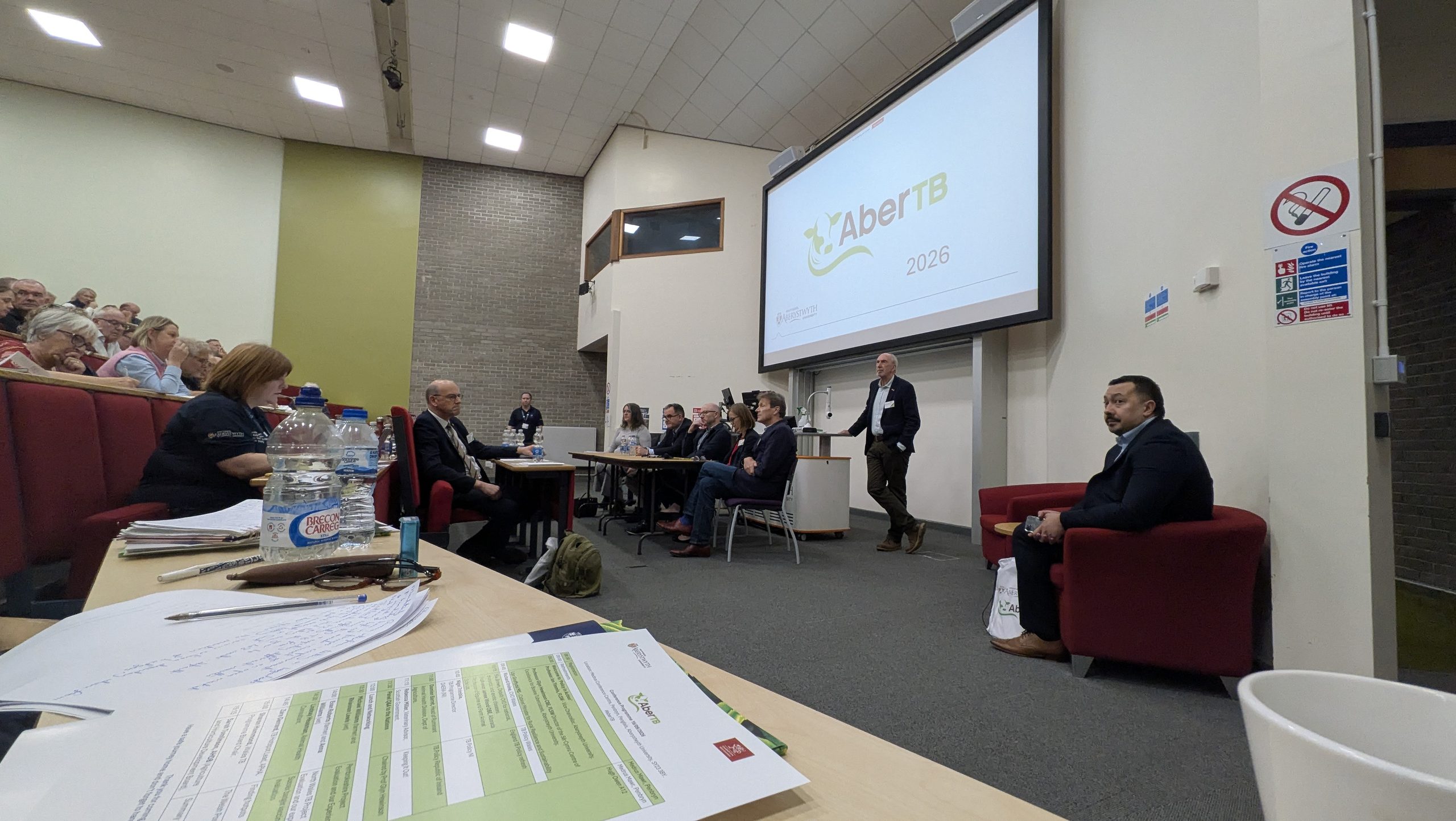
Dan Rose, Chair of Clwyd Badger Group, attended the AberTB 2026 conference at Aberystwyth University on 16 September, joining leading researchers, veterinary professionals, policymakers, farmers and industry representatives from across the UK and Ireland to discuss the ongoing challenge of bovine tuberculosis (bTB).
This year’s conference, themed Policy in Action, brought together expertise from across the four UK nations and Ireland to examine different approaches to controlling and eradicating bTB. Discussions explored current government policies, emerging research and the practical challenges of tackling the disease in cattle herds and wildlife.
Leading experts and policymakers
The conference opened with contributions from Llyr Gruffydd MS, Welsh Government Cabinet Minister for Rural Resilience and Sustainability, and Professor Glyn Hewinson, Director of the Sêr Cymru Centre of Excellence for Bovine Tuberculosis at Aberystwyth University.
Professor Hewinson is a leading authority on bTB, with decades of experience in disease research, diagnostics and vaccine development. His work has included leading scientific research at the Animal and Plant Health Agency and contributing to the development of diagnostic tests and vaccines for both cattle and badgers.
Other key speakers included Dr Richard Irvine, Chief Veterinary Officer for Wales, and Ele Brown, Deputy Chief Veterinary Officer for national, domestic and exotic diseases at Defra, alongside other veterinary experts, government advisers and researchers. Their contributions provided insight into the policies and practical considerations shaping disease control across the UK.
Delegates also heard updates on projects in North Wales and Pembrokeshire, where researchers, farmers and veterinary professionals are working together to identify and manage disease risks, improve farm biosecurity and develop approaches tailored to individual herds.
Examining the evidence on badgers and bTB
For Dan, attending the conference was an important opportunity to hear directly from specialists, examine the evidence behind different disease control policies and consider the implications for badger conservation in Wales.
“We need to be guided by the science, not assumptions about badgers. Bovine TB is a complex disease, and we need to be honest about what the evidence does and does not tell us. Badgers have too often been blamed for a problem that requires a much broader approach.
“It was valuable to hear from specialists and policymakers working across different parts of the UK. We need to understand what is working, what the evidence shows and where further research is needed, rather than assuming that one intervention will solve such a complicated problem.”
Dan also highlighted the importance of exercising caution when comparing bTB statistics between Wales and England. Differences in testing regimes, surveillance and the handling of inconclusive test results can affect the figures and how they should be interpreted. Comparisons need to account for these differences before conclusions are drawn about the effectiveness of different policies. Wales has already achieved 96.3% btb free herds, without killing badgers.
Protecting cattle and wildlife
For Clwyd Badger Group, the priority is to support effective, evidence-led measures that tackle bTB while protecting badgers from unnecessary harm. This includes examining the contribution of cattle testing, improved biosecurity, herd management and vaccination, alongside continued research into disease transmission.
The conference provided an opportunity to hear about the approaches being explored across different administrations, and to consider how research and practical experience can inform future policy. Collaboration between scientists, veterinary professionals, farmers, governments and wildlife organisations remains an important part of addressing the disease.
Dan’s attendance reflects Clwyd Badger Group’s commitment to engaging with the scientific and policy discussions that affect badgers across North Wales.
Clwyd Badger Group will continue to advocate for effective cattle disease control and the protection of badgers, calling for decisions to be based on robust scientific evidence, transparent evaluation and a clear understanding of the limitations of the available data.